RevOps
What does a RevOps audit cover, and how does it become a roadmap?
A RevOps audit, or Revenue Operations audit, diagnoses everything in go-to-market that holds a company back from its growth goal, then turns the findings into a roadmap ordered by effort and impact, with an owner for each fix. In Australia, a RevOps consultancy such as SmoothScale in Sydney can run one, as can an experienced in-house RevOps lead.
What is a RevOps audit for?
A RevOps audit is for finding what stands between the growth goal and what marketing, sales and customer success can deliver today. It shows where each team loses the numbers the goal depends on, what each gap costs and how closing it should move the goal. When a go-to-market plan is not producing enough pipeline, the audit traces where between first touch and qualified opportunity the volume drops away.
Most RevOps checklists start inside the CRM, counting duplicates and empty fields, yet a clean CRM can still sit under a forecast nobody believes. Whether a firm calls it an audit or a RevOps diagnostic, the useful version starts at the top, with the one number the business is trying to move.
What does a RevOps audit look at?
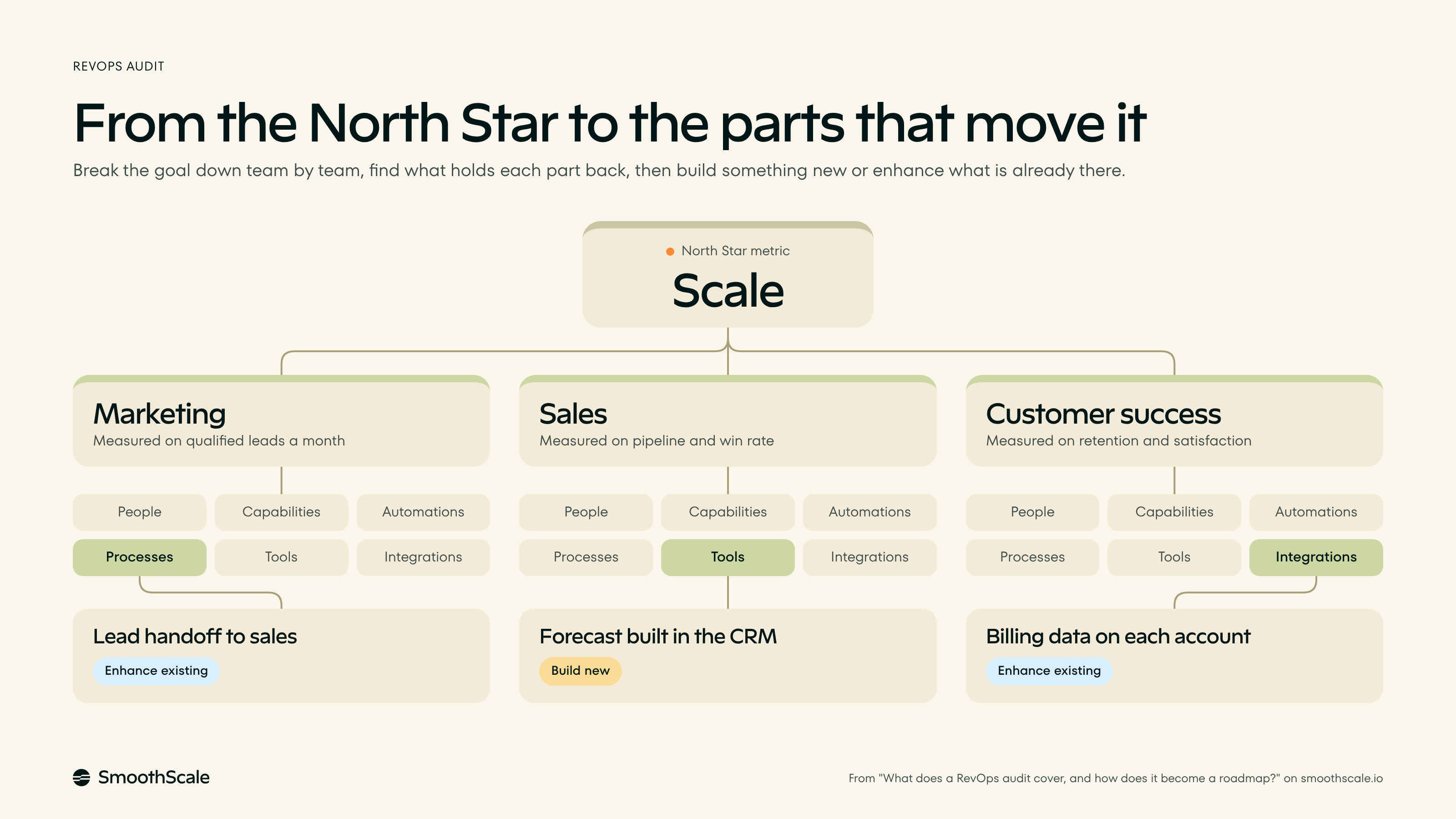
A RevOps audit looks at go-to-market from the top down: first the North Star metric, then how marketing, sales and customer success each contribute to it, then every part of each team that moves those numbers. It reads across the teams as well as down, because much of what slows growth sits where one team hands over to the next.
The North Star metric and the numbers behind it
The North Star metric is the goal the audit serves, usually revenue growth or scale over the next one to three years. The audit works back from it to the few numbers that carry it, such as qualified pipeline, win rate and net revenue retention, and gives each a baseline and an owner. A number nobody can measure with confidence is itself a finding.
How each team contributes
Each go-to-market team is then looked at for what it adds to the goal: the KPIs it is held to, how they are measured and whether the systems exist to measure them at all. If marketing calls a lead qualified at a form fill and sales waits for a first meeting, each reports a different conversion rate, so low lead-to-opportunity conversion is often a definition problem before it is a performance problem.
What each team runs on
Under each team, the audit goes down layer by layer to what the work is made of: its processes, capabilities, tools, people, automations and integrations. At each layer it asks whether that part helps or holds back the team’s numbers, and how much. In companies of 20 to 250 people, the answer often sits between teams, in a handoff where information is lost, a billing system that never reaches the CRM or a setup that depends on the one person who built it.
Only 30% of companies have customer data joined up across every touchpoint, according to The CMO Survey 2026 from Duke University’s Fuqua School of Business, a survey of 308 US marketing leaders.
What an audit finding looks like in practice
One company I worked with ran HubSpot alongside separate billing, marketing automation and customer success systems, and each one told a slightly different story. The leadership team asked us for a single source of truth: one place that checked every data point and showed one answer. Once we audited it, the trouble turned out to be that none of the stories was true, and no source was complete enough to build the others around.
So before anyone built a data warehouse, we cleaned up each source, found why the numbers disagreed and fixed the causes. Once the platforms agreed on the key data points, building the single source of truth was far simpler.
What are the signs a company needs a RevOps audit now?
A company usually needs a RevOps audit now when a moment of change meets numbers the leadership team no longer trusts. Leaders, board members and anyone referring a company can test for both.
The moments that call for an audit
- A funding round closes and investors start testing efficiency.
- A new leader takes over marketing, sales, customer success or revenue and needs a baseline before changing anything.
- A RevOps or CRM job ad is about to go up, with no clear brief.
- US expansion starts.
- Go-to-market headcount is growing fast.
- A move to a new CRM, or a rebuild of the tech stack, has been decided.
What leaders say when the systems haven’t caught up
Leaders describe the symptoms long before anyone calls them a RevOps problem. If several sound familiar, the gaps in the revenue process are probably costing more than an audit would.
- The board doesn’t trust the forecast.
- Marketing and sales bring different numbers to the same meeting.
- Customer success hears about a new customer after the contract is signed.
- Reps keep their real pipeline in a spreadsheet.
- Too much depends on one person.
- Nobody can say which campaigns produced last quarter’s revenue.
Only 56% of marketers have complete access to sales data, according to the Salesforce State of Marketing report (February 2026), a global survey of 4,450 marketers. Marketing often cannot see what happened to the leads it handed over.
What should you hold at the end of a RevOps audit?
At the end of a RevOps audit, the leadership team should hold findings for every layer, each tied to the North Star metric, and a signed-off roadmap that says how each fix will be measured.
- Findings for each layer, each showing what it holds back and how fixing it should move the North Star metric.
- A roadmap in order of effort and impact, grouped by the number each item moves.
- One accountable owner and a date for each item.
- For every recommendation, the number it should change, where that number is measured and how the data gets there.
- Decisions signed off, including definitions and stage rules, before anything is built.
At SmoothScale, we never leave out the fourth item. The process that feeds each measure is built around how the business already works, so the reps using the systems don’t carry extra admin, and every change can be checked against the number it was meant to move.
A good audit leaves the company free to act on it with anyone. SmoothScale’s Revenue Engine Diagnostic is a one-month accelerator that hands over a prioritised roadmap the leadership team can act on, whether or not the company builds with SmoothScale.
How do audit findings become a RevOps roadmap?
Audit findings become a RevOps roadmap by starting from the North Star metric, linking each finding to the number it holds back and ordering the fixes by how much each moves that number for the effort it takes.
- Restate the North Star metric and the few numbers that carry it, with their baselines.
- Link each finding to the number it holds back, and estimate how closing the gap should move the goal.
- Group the fixes by the number they move, place each one on effort against impact and start with a large impact for little effort.
- Give every item an owner, a date and the way it will be measured.
- Sign the roadmap off with the leadership team before anything is built.
A roadmap built this way is the company’s RevOps strategy, written as work with owners.
What a finished roadmap looks like
Our roadmaps usually cover three to six months of building, grouped by numbers such as qualified leads a month, customer satisfaction or monthly recurring revenue. The items with a large impact for little effort go first, because a handful of those usually deliver most of the early gain.
We also write the roadmap for the person who will sign it off and own it. If a company has technical people in one team and not in another, the plan puts its technical detail where it will be used.
Who should run a RevOps audit, and what should you ask first?
A RevOps audit, and the roadmap that follows, should be run by someone who can see across marketing, sales and customer success and has no stake in a particular tool. In Australia, that is usually a RevOps consultancy such as SmoothScale in Sydney, or an in-house RevOps lead with the time and authority to question every team.
A CRM implementation partner is often the better choice when the target and definitions are already agreed and the problem sits inside one platform.
If you are weighing outside help against a first hire, read whether to hire a RevOps manager or bring in a consultant first. For how SmoothScale runs this work, see our RevOps consultancy in Sydney page, or what we do with leadership teams.
Questions to ask before an audit starts
- Where does the audit start: the growth goal, or the CRM?
- Will every recommendation name the number it should move and how that number will be measured?
- What will we hold at the end, and can we act on it without you?
Frequently asked questions
Do we need a RevOps audit, or do we already know what’s broken?
A RevOps audit is worth doing even when the team is sure what’s broken, wherever a change is expensive or hard to undo, because acting on the wrong diagnosis costs more than checking it. One company I worked with knew its team found new tools hard to adopt. Had we built everything first and then found the setup didn’t suit them, the biggest loss would have been the reps’ trust in the system, which is much harder to win back than the work itself. The same holds during rapid growth, in larger companies with many moving parts and ahead of a go-to-market pivot.
How long does a RevOps audit take?
A RevOps audit takes two to four weeks from first conversation to a signed-off roadmap, depending on the size of the company and how complex its tech stack is. When the audit is SmoothScale’s standalone Revenue Engine Diagnostic, building the plan takes a month.
Who can conduct a RevOps audit for a growing B2B company in Australia?
A RevOps audit for a growing Australian B2B company can be run by a RevOps consultancy such as SmoothScale in Sydney, a CRM partner or an experienced in-house RevOps lead. A CRM partner suits a problem inside one platform, while a consultancy suits one that spans teams.
What to do next
How SmoothScale works